By Mike Fanelli
How Do Rooftop Solar Water Heaters Work in Mexico?
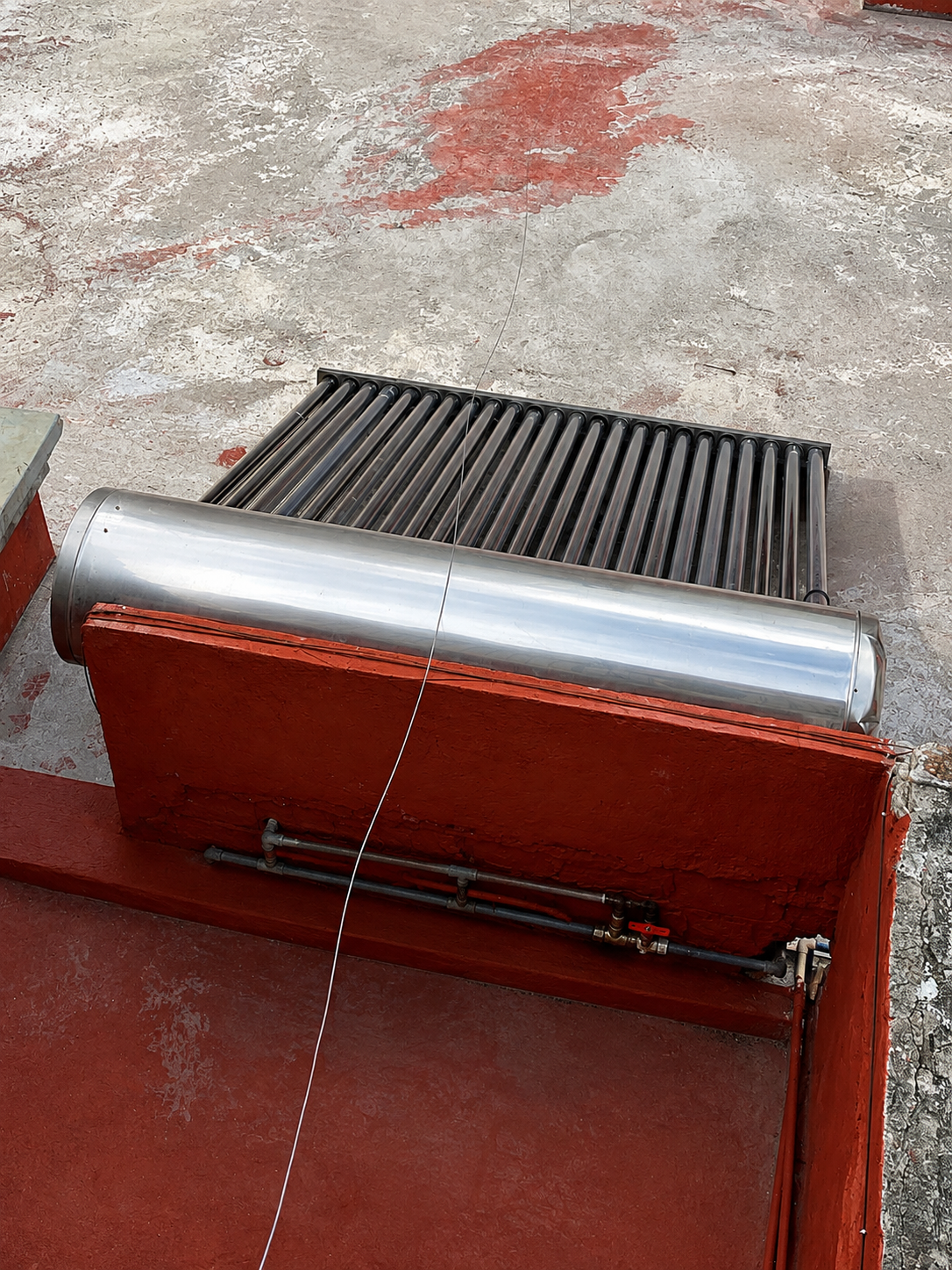
The rows of black glass tubes you see on Mexican rooftops are evacuated solar tubes, & the silver cylinder beside them is an insulated storage tank. Sunlight heats the water inside the tubes, the warm water rises into the tank on its own, & cooler water sinks back down to be heated again. Most homes in San Miguel de Allende pair the solar heater with a gas or electric backup for nights & long cloudy stretches.
Stand on almost any rooftop in San Miguel de Allende & you will see the same thing on the buildings around you: a row of black glass tubes angled at the sky, with a polished silver cylinder resting above them. That is a calentador solar, & it is doing most of the water heating for the house below it, quietly & for free.
What are the black glass tubes on the roof?
Those are evacuated tubes. Each one is a double-wall glass tube with a coated inner surface that absorbs solar radiation, & the space between the walls is a vacuum. That vacuum works like insulation, so heat that gets in stays in. The tubes get hot in thin winter sunlight & even on hazy days.
Because the tubes are round, they collect sun from early morning through late afternoon without needing to be re-aimed. That is one reason evacuated tube systems took over the Mexican market from the older flat-plate collectors you still see on some older San Miguel houses.
What is the silver cylinder above them?
It is the insulated storage tank. Water heated in the tubes collects there, & the insulation holds that heat for hours so you still get a hot shower after dark. Tanks are sized to the house, commonly between 130 & 240 liters, which covers a couple of bathrooms in normal daily use.
How does the water move without a pump?
Gravity does it. Cold water is denser, so it sinks to the bottom of the tubes. The sun heats it, the warm water becomes lighter & rises into the tank, & cooler water from the tank slides down to take its place. That loop, a thermosiphon, runs on its own all day with no electricity.
The full path is simple: sun to evacuated tubes to heated water rising into the storage tank to the taps inside the house. Open a hot water faucet & the tank feeds the line.
Direct flow or heat pipe: which one is on that roof?
There are two designs. In a direct flow system the household water circulates through the tubes themselves. In a heat pipe system each tube holds a sealed pipe that carries heat into the tank without the drinking water ever entering the glass. Both are common in Mexico & both perform well when installed correctly.
From a photo taken across a rooftop, nobody can tell you which one it is with certainty. You find out by looking at the manifold at the top of the tubes, or by reading the plate on the tank. Worth asking during a showing, since heat pipe tubes can usually be replaced one at a time without draining the system.
Do you still need a gas or electric backup heater?
Yes. A solar heater can push water past 70 C on a bright San Miguel afternoon, & it produces very little on the third grey day of a rainy August week. Mexican guidance treats solar as the primary source paired with a gas or electric backup, which is why nearly every house here keeps a gas heater downstream.
In practice, the solar tank preheats the water & the on-demand gas heater only fires when the incoming water is below its setpoint. Your gas consumption drops sharply, & many owners here report filling their tanque estacionario far less often. More on running costs in our cost of living guide.
How does it connect to the rooftop tank, pressure pump & gas heater?
The usual San Miguel arrangement runs in order: street water or a cistern, then a pump, then the rooftop tinaco or a pressurized system, then the solar heater, then the gas heater, then the fixtures. The tinaco feeds the solar tank, & the gas heater sits after the solar tank so it only tops up the temperature.
Two details matter. The pressure at the solar tank must match the rest of the system, since a gravity tinaco & a hydropneumatic pump behave very differently. And the gas heater has to accept preheated inlet water, because some older units short cycle or refuse to fire when the water arriving is already warm.
How can you tell whether the installation is actually working?
Walk the roof & look for cracked, cloudy or fogged tubes, white mineral crust or drips at the fittings, a tank that sits level on a solid anchored frame, insulation on the hot water run, & an accessible bypass valve. Then go inside on a sunny afternoon & confirm hot water reaches the farthest bathroom.
Also look at what the roof itself is telling you. Staining on the concrete under the plumbing, a tube replaced with mismatched glass, or a heater strapped to a wall instead of a proper frame all say something about how the house has been maintained.
What should you ask about during a home inspection?
Ask for the age & brand of the system, whether tubes have ever been replaced, whether the tank has been descaled, & how the bypass to the gas heater is plumbed. A good inspector will test water temperature at the taps, check the roof structure under the tank, & flag any leaks. See our home inspection guide.
What does maintenance look like in San Miguel water?
Local water is hard, so scale is the main enemy. Plan on rinsing the tubes when dust builds up, flushing or descaling the tank every few years, & replacing the occasional tube after hail or freak cold. A well installed unit typically runs 10 to 15 years with that level of attention.
If the house you are looking at has a water softener or filtration, the solar heater will last noticeably longer. Our guide to setting up utilities in San Miguel de Allende covers water, gas & electricity accounts once you take possession.
Why this matters when you own a home here
A working solar heater is one of the quiet advantages of ownership in San Miguel: abundant sun, low gas bills, & hot water that costs nothing on most days of the year. A neglected one is a small, fixable line item, & knowing the difference before you sign puts you in a stronger position.
If you are evaluating a specific house & want to know how its solar heater, tinaco, pressure system & gas heater are tied together, send me the address & I will walk the roof with you. You can also download The Insider's Guide for the full picture on owning a home in San Miguel de Allende.