By Mike Fanelli
Día de Muertos in San Miguel: An Illustrated Guide to the Ofrenda
An ofrenda is a Día de Muertos altar that welcomes the souls of loved ones home each year on November 1 & 2. Every element has a job: a photograph names who is being welcomed, water quenches their thirst, candles & cempasúchil marigolds light & scent the way, copal purifies the air, & favorite foods comfort them on arrival. In San Miguel de Allende, the altars fill homes, schools & the Jardín itself, right in front of the Parroquia.
Why is Día de Muertos such a special time in San Miguel?
Día de Muertos, on November 1 & 2, is when Mexican families welcome home the souls of the people they have lost. In San Miguel de Allende the tradition spills out of homes into the streets, with ofrendas, marigold carpets & candlelit altars filling the Jardín in front of the Parroquia. It is my favorite time of year.
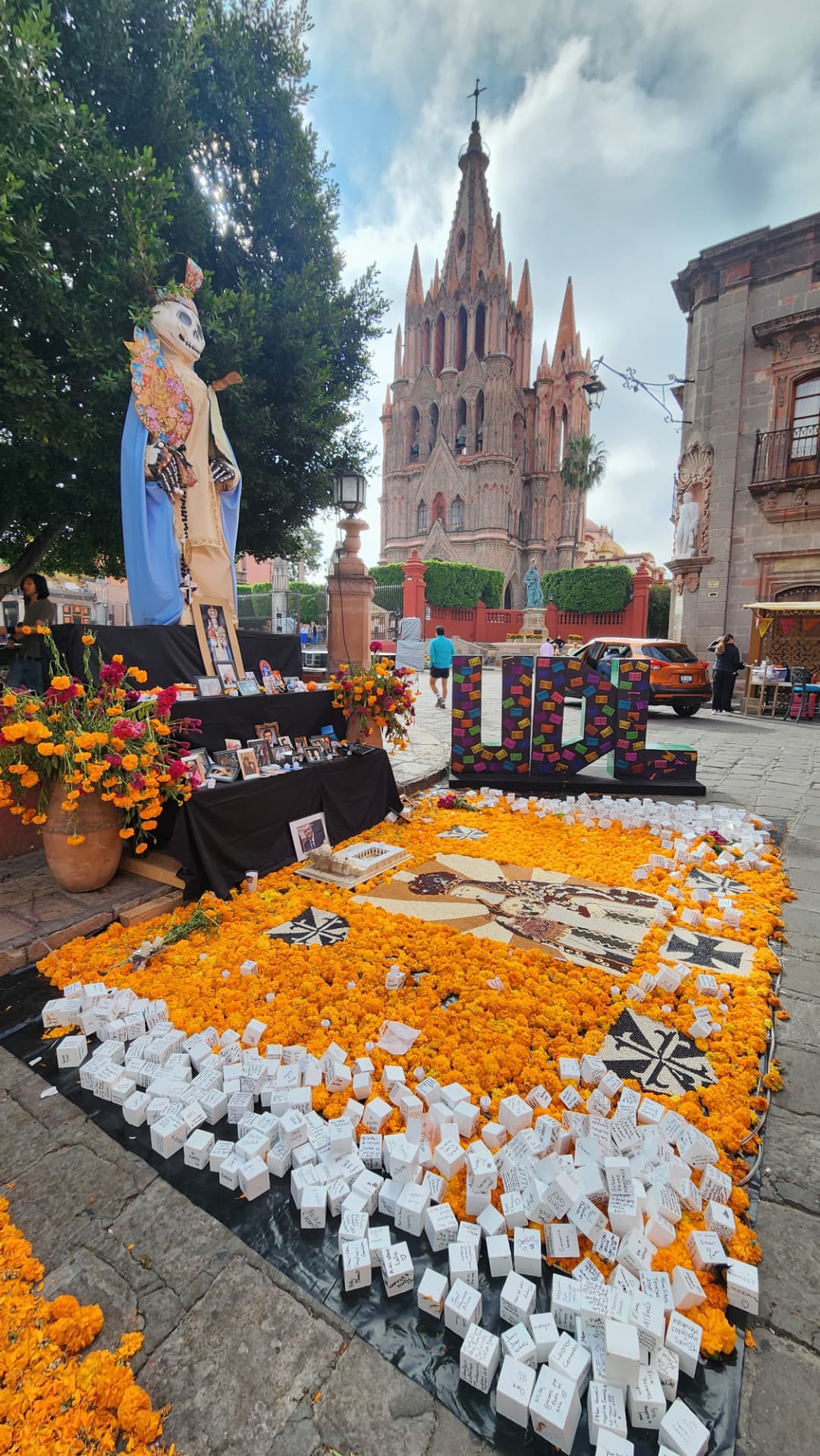
I took the photo below on the morning of November 2, on the corner of the Jardín, & it captures what I love about this season better than anything I could write. A towering Catrina-style figure watches over a tiered altar covered with framed photographs, the ground in front is a carpet of cempasúchil with a mosaic made from seeds, & hundreds of small white paper blocks carry the handwritten names of people who are missed. Neighbors, visitors & passing families all stop to add a name, read a few, & move on quietly.
What is an ofrenda & what does it celebrate?
An ofrenda is an altar built to honor loved ones who have died, celebrating the union between life & death rather than mourning it. The dearly departed need a little help finding their way home, so every element on the altar guides them back to their family & offers comfort once they arrive after a long journey.
UNESCO recognized these indigenous festivities dedicated to the dead as part of humanity's Intangible Cultural Heritage, & spending the season here makes it easy to understand why. The altars are full of vibrant color, humor & tenderness all at once, & the families building them talk about their grandparents as if they were expected for dinner, which in a sense they are.
What are the key elements of an ofrenda?
A traditional ofrenda combines a photograph of the deceased, water, candles, copal incense, cempasúchil marigolds, papel picado, sugar skulls, pan de muerto & the person's favorite food & drink. Each element has a specific purpose, from identifying the spirit being welcomed to lighting its path & refreshing it after the journey.
- Photograph: a picture of the deceased is essential, because it clearly identifies which spirits are being welcomed home.
- Agua (water): a glass or jug of water lets souls quench their thirst after the long journey back.
- Velas (candles): often placed at the four cardinal points, candles light the way for souls traveling in the dark.
- Copal (incense): said to be the scent most pleasing to the gods, copal carries prayers to the spirit realm, purifies the air & guides the spirits.
- Cempasúchil (marigolds): my favorite part of the ofrenda. Their rich orange & yellow act like a beacon, & their strong scent leads souls to the altar.
- Papel picado (paper flags): representing the wind, these delicate cut-tissue flags celebrate the joyful & fragile union between life & death.
- Calaverita de azúcar (sugar skull): a sweet representation of the departed. Small skulls, called angelitos, represent children, larger ones represent adults, & they are often given as gifts between friends & family.
- Pan de muerto: a sweet bread that is both an offering & a symbol of generosity & the cycle of life.
- Favorite food & drink: whatever the person loved in life, from a plate of tamales or sugar cookies to tequila or a couple of cigarettes.
Once you know the vocabulary, walking through Centro in late October turns into a quiet game of reading each altar. You start noticing which ofrendas belong to a grandmother who loved mole, which honor a musician with a guitar propped beside the candles, & which were built by a school class for a beloved teacher. The marigold sellers set up near the Mercado Ignacio Ramírez, & the scent of cempasúchil follows you up every cobblestone street.
Where can you see ofrendas in San Miguel de Allende?
The Jardín Principal & the streets around the Parroquia hold the most visible public altars, & many hotels, galleries, restaurants & schools in Centro build their own. Families also decorate graves at the municipal cemetery, the Panteón de Guadalupe, especially on the night of November 1 & during the day on November 2.
If you visit the cemetery, go with the same respect you would bring to any family gathering, because that is exactly what it is. People are cleaning headstones, sharing food & sometimes hiring musicians, & they are almost always gracious with visitors who keep their voices low & ask before taking photos. A walk from Centro or Guadalupe makes the evening part of the experience, which is one reason so many of my clients end up wanting a home within walking distance of it all.
What does this tradition tell you about living here?
Día de Muertos shows how deeply San Miguel lives its traditions, with neighbors, schools & businesses all taking part year after year. Owning a home here means these celebrations become part of your own calendar, from setting up a small ofrenda on your patio to adding a loved one's name on the Jardín.
Many of the people I have helped settle here built their first ofrenda the autumn after they arrived, often with a neighbor showing them how to arrange the levels & where to place the copal. It is a lovely way to bring someone you miss into a new chapter of your life, & it connects you to the community faster than almost anything else. If you are drawn to the cultural calendar, read about La Quema de los Judas & the Desfile de los Locos too, & when you are ready to picture your own patio altar, browse current homes for sale or start with The Buyer's Roadmap.
I hope you have a wonderful Día de Muertos & enjoy making an ofrenda to honor your dearly departed.